Bat Detector (TBC)

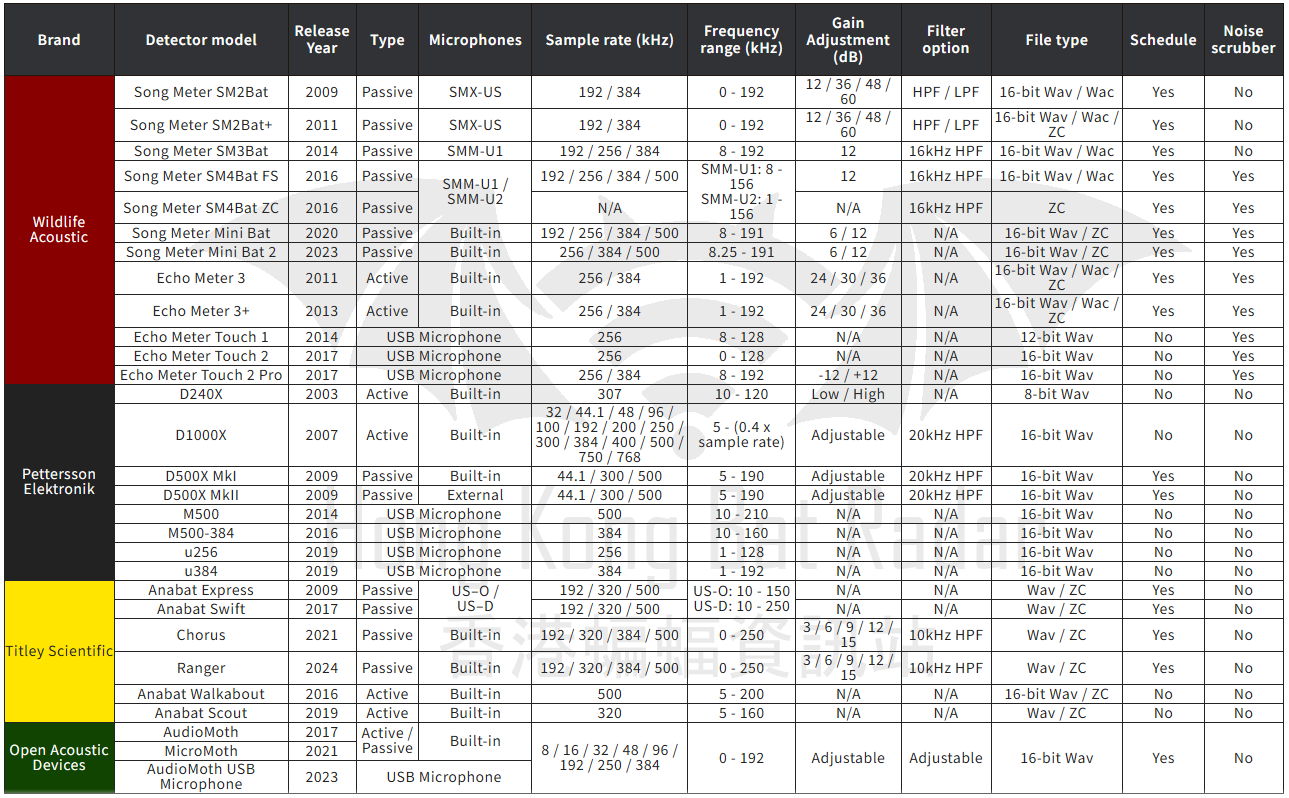
Bat detectors are specialized devices used in bat research and conservation. Different models have varying technical specifications and functionalities, requiring careful selection to suit the specific needs of a project. Factors such as frequency range, signal to noise ratio, and recording capabilities must be considered to ensure the most appropriate detector is chosen, as the selected device can significantly impact data quality and accuracy. Thorough evaluation of project objectives and available detector capabilities is essential for obtaining reliable and meaningful results from bat-related studies and monitoring programs.

Five main systems

Heterodyne

Heterodyne

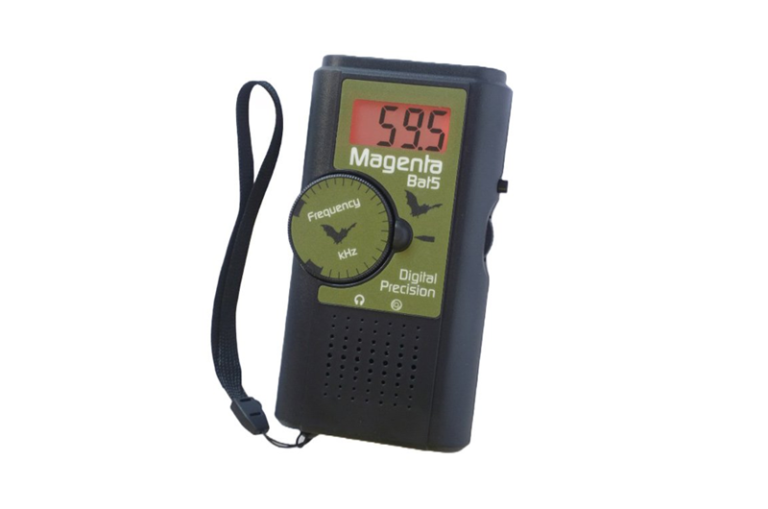
Tuneable detector that converts bat calls to audible frequencies by mixing with a local oscillator with the desired frequency.

Frequency Division

Frequency Division

Broadband detector that outputs detected sound in real-time, with frequencies divided by (eg. 10) for recording.

Zero Crossing

Zero Crossing

Broadband detector that records sounds as data points showing frequency changes over time.

Time Expansion

Time Expansion

Broadband detector that captures a short sound sample and plays it back at a slower speed (x10 / x20) for recording.

Full Spectrum

Full Spectrum

Broadband detector that records sound in real-time at original frequencies using high sampling rates.

Important specification

Sampling rate

Sampling rate

The maximum recordable frequency is determined by the sampling rate where a sample rate of 256 kHz allows the recording of sounds up to 128 kHz (half the sample rate). It also determine the resolution of spectrogram and power spectrum.

Gain level

Gain level

Adjusting the gain allows the recorder to optimize the dynamic range and signal strength for the specific recording environment and bat species being monitored. This ensures the recordings have the best possible quality for subsequent analysis.

Bit depth

Bit depth

The bit depth of a bat recorder is crucial as it determines the dynamic range and signal-to-noise ratio captured. Higher bit depths, such as 16-bit or 24-bit, allow for higher resolution of amplitude, enabling better analysis and identification.

Signal-to-noise ratio

Signal-to-noise ratio

A high signal-to-noise ratio ensures bat calls are clearly distinguishable from background noise, enabling accurate species identification and detailed acoustic analysis.

Trigger

Trigger

The trigger setting  determines when the recorder starts and stops capturing audio, ensuring only bat calls are recorded and reducing file sizes. Proper trigger settings minimize background noise and optimize storage space, enabling more effective survey.

Auto noise detection

Auto noise detection

Auto noise detection and trash feature automatically identify and filter out non-bat sounds, such as wind, rain and insect noise. It reduces the amount of manual post-processing required, saving time and effort.

Real-time spectrogram

Real-time spectrogram

Real-time spectrogram display allows users to instantly visualize the frequency and temporal characteristics of bat calls, enabling on-site identification, observation and adjustment of recording parameters.

Weatherproof

Weatherproof

It protects the device from environmental elements like rain, wind, and dust, ensuring uninterrupted operation and data collection. It also extends the recorder’s lifespan and reliability, enabling long-term, continuous monitoring of bat activity under diverse outdoor conditions.

Bat detector products

Wildlife Acoustic
Pettersson Elektronik AB
Titley Scientific
Open Acoustic Devices

Bat detector advised for Hong Kong bats

Hong Kong is home to 25 bat species, whose echolocation calls span a frequency range of 16-130 kHz, with all Yangochiroptera species falling between 20-60 kHz.

Echo Meter Touch 2 Pro

Professional bat detectors offer 384 kHz sampling rate, 16-bit depth, high signal-to-noise ratio, and 3-level gain adjustment, optimizing recordings for detailed call analysis across diverse survey environments.

Purpose:  Active bat acoustic survey, Acoustic analysis

Specification

Sample rate: 256 / 384 kHz

Frequency range: 10 – 192 kHz

High-pass filter: 10 kHz

Bit-depth: 16-bit wav

Noise-Scrubbing: Yes

Gain adjustment: Yes (3 Levels)

GPS track: Yes

Audio output: HET(auto)/TE/RTE

Real-time spectrogram: Yes

Echo Meter Touch 2

Affordable bat detectors offer 256 kHz sampling rate and fair signal-to-noise ratio, but lack gain adjustment, potentially missing quiet, distant or high-frequency bats (especially Hipposideros gentilis) compared to Pro version.

Purpose:  Education, Citizen science program

Specification

Sample rate: 256 kHz

Frequency range: 10 – 128 kHz

High-pass filter: No

Bit-depth: 16-bit wav

Noise-Scrubbing: Yes

Gain adjustment: No

GPS track: Yes

Audio output: HET(auto)/TE/RTE

Real-time spectrogram: Yes

Song Meter SM4BAT FS

Professional bat detectors with external microphone offer 500 kHz sampling, 16-bit depth, high signal-to-noise ratio, and gain adjustment, optimizing recordings for detailed call analysis across diverse survey environments.

Purpose:  Passive bat acoustic survey, Acoustic analysis

Specification

Sample rate: 192 / 256 / 384 / 500 kHz

Frequency range: 1 – 156 kHz

High-pass filter: optional 16 kHz

Bit-depth: 16-bit wav

Output format: wav / w4v / zc

Noise-Scrubbing: Yes

Gain adjustment: Yes (2 Levels)

Run-time: 48 10-hour nights

Song Meter Mini 2

Professional bat detectors with built-in microphone offer 500 kHz sampling, 16-bit depth, high signal-to-noise ratio, and gain adjustment, optimizing recordings for detailed call analysis across diverse survey environments.

Purpose:  Passive bat acoustic survey, Acoustic analysis

Specification

Sample rate: 256 / 384 / 500 kHz

Frequency range: 8.25 – 191 kHz

High-pass filter: 8.25 kHz

Bit-depth: 16-bit wav

Output format: wav / zc

Noise-Scrubbing: Yes

Gain adjustment: Yes (3 Levels)

Run-time: 125 10-hour nights